Ziwei Yang, Ph.D.
01 · Model Biology · Mechanistic Biological Modeling

DeepGDel

Deep sequence learning for growth-coupled gene deletion prediction

DeepGDel turns gene deletion design into a prediction task: it learns from known deletion strategies, using gene and metabolite sequences, to predict which genes to delete so that a target metabolite is produced together with cell growth.
Metabolic ModelingMetabolic Engineering Ziwei Yang, Takeyuki Tamura · IEEE Transactions on Computational Biology and Bioinformatics, 2025
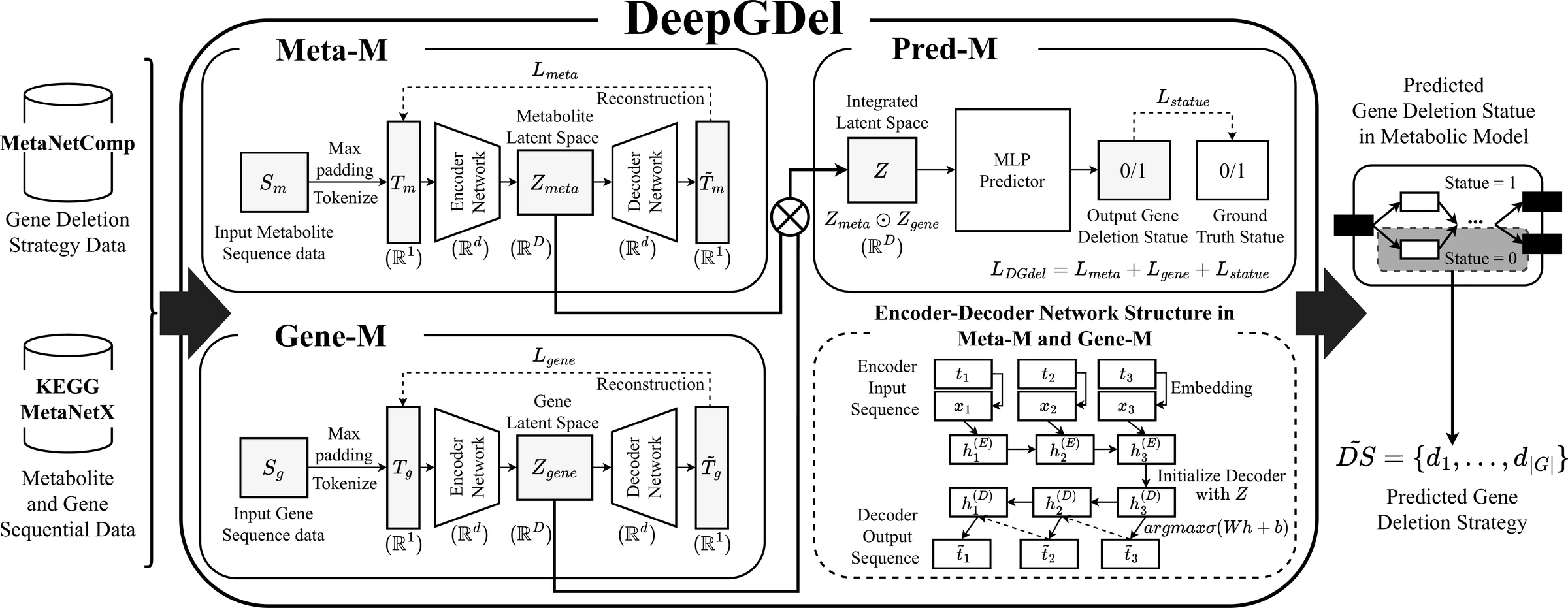
DeepGDel framework: gene deletion strategy data from MetNetComp and metabolite and gene sequences from KEGG and MetaNetX feed Meta-M and Gene-M, two encoder–decoder networks whose latent vectors are combined in Pred-M to predict the deletion status of each gene.
DeepGDel at a glance. Meta-M and Gene-M learn latent representations of metabolite and gene sequences; Pred-M combines them to predict, gene by gene, the deletion strategy for a target metabolite. Figure adapted from Yang & Tamura, IEEE TCBB 2025.

Overview

To make a microbe produce a useful compound, metabolic engineers often delete genes so that the compound is made as a by-product of growth. This growth-coupled production stays stable because faster-growing cells take over a culture. Algorithms that compute such deletion strategies on genome-scale metabolic models are slow, but databases such as MetNetComp already hold many computed strategies.

DeepGDel asks whether those strategies can be learned. For a target metabolite it predicts, for every gene in the model, whether the gene should be deleted or kept, using only sequence data: the metabolite's SMILES string and the amino-acid sequences of the genes.

The paper formulates gene deletion strategy prediction as a learning problem. GraphGDel later extended the framework with the structure of the metabolic network.
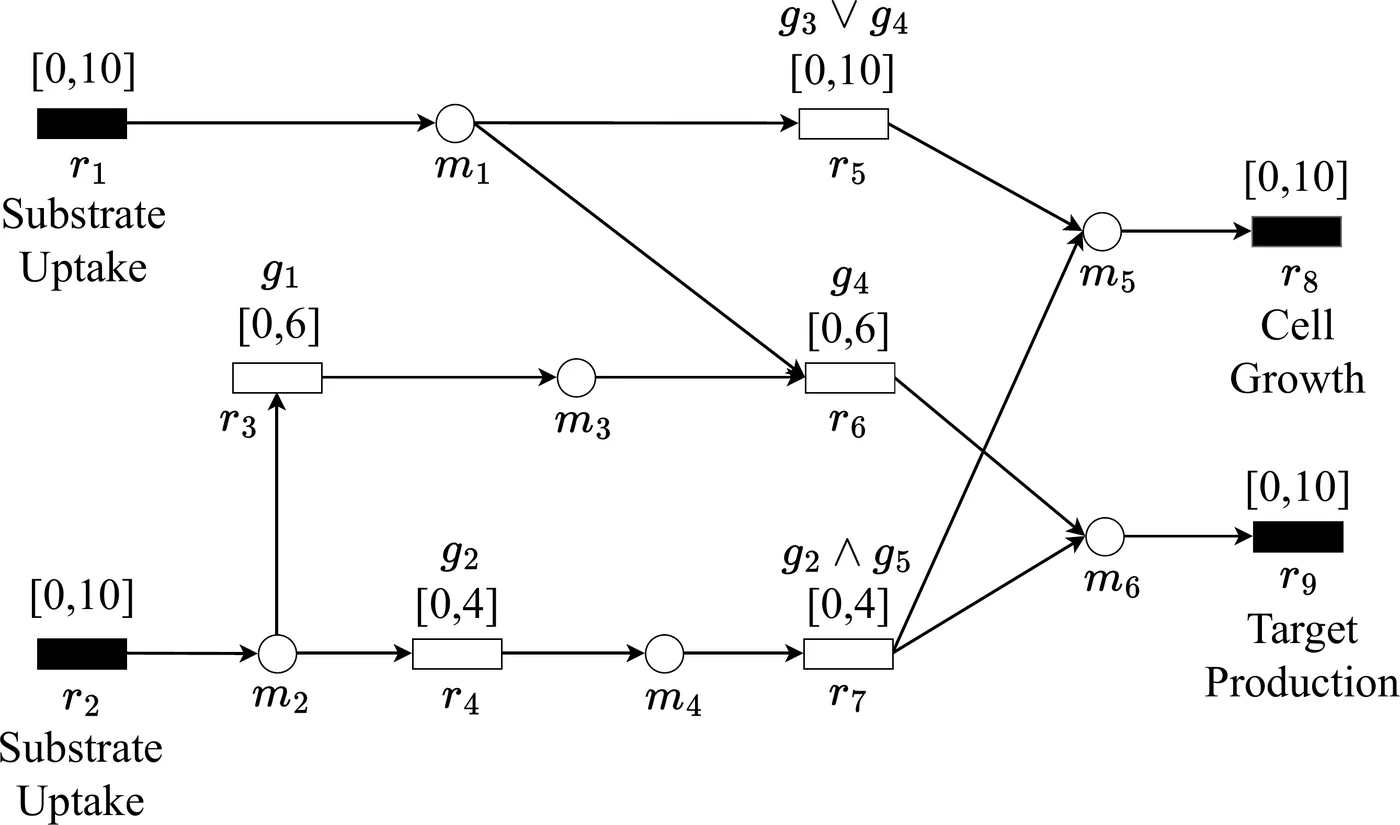
Toy constraint-based model with metabolites m1 to m6, two substrate uptake reactions, a cell growth reaction r8 and a target production reaction r9; internal reactions carry flux bounds and gene rules such as g3 or g4, and g2 and g5.
The problem on a toy constraint-based model (Fig. 1 of the paper). Circles are metabolites, rectangles are reactions with flux bounds, and gene rules such as g2 ∧ g5 decide which reactions remain after deletions. A good deletion strategy leaves the cell able to grow (r8) only while it also produces the target (r9). Figure adapted from Yang & Tamura, IEEE TCBB 2025.

Method

Three neural modules, trained together with one combined loss.

  1. 01

    Meta-M: encode the metabolite

    An LSTM encoder–decoder reads the target metabolite's SMILES string and compresses it into a latent vector, learned by reconstructing the input sequence.

  2. 02

    Gene-M: encode the genes

    A second encoder–decoder does the same for the amino-acid sequences of the model's genes.

  3. 03

    Pred-M: predict the strategy

    The two latent vectors are combined element-wise and passed to an MLP that outputs, for each gene, deleted (0) or kept (1). Reconstruction and prediction losses are summed.

Key Results

Overall accuracy

71.90%
e_coli_core
E. coli core model
79.78%
iMM904
S. cerevisiae (yeast)
67.24%
iML1515
genome-scale E. coli

Overall accuracy of gene deletion status prediction (mean of 5 × 10-fold cross-validation): 14.69, 22.51 and 13.03 points above the non-learning BPM baseline, and 9.22, 9.80 and 6.80 points above a deep neural network.

Benchmark

Overall accuracy: baselines and ablations DeepGDelAblationsBaselines
e_coli_core
BPM 57.21 ±5.17
DNN 62.68 ±2.67
Meta only 56.05 ±0.57
Gene only 62.14 ±0.45
DeepGDel 71.90 ±0.45
iMM904
BPM 57.27 ±7.89
DNN 69.98 ±1.57
Meta only 64.86 ±0.58
Gene only 72.97 ±0.46
DeepGDel 79.78 ±0.44
iML1515
BPM 54.21 ±1.82
DNN 60.44 ±1.03
Meta only 54.05 ±0.57
Gene only 61.16 ±0.44
DeepGDel 67.24 ±0.34
Overall accuracy (%), mean ± s.d. over 5 × 10-fold cross-validation. BPM: proportion-and-threshold baseline with no learning; DNN: deep feedforward network; Meta only / Gene only: DeepGDel with only the metabolite or only the gene branch. Data from Tables VIII and IX of the paper (arXiv v5); redrawn.

Resources

Paper

DeepGDel: Deep Learning-based Gene Deletion Prediction Framework for Growth-Coupled Production in Genome-Scale Metabolic Models

IEEE TCBB 2025 · preprint on arXiv (v5)

Code

MetNetComp/DeepGDel

Source code