GraphGDel
IEEE TCBB 2026
Builds graph representations of genome-scale metabolic models and learns from them, together with gene and metabolite sequences, to predict growth-coupled gene deletion strategies.
Using known gene deletion strategies to speed up the search for new ones
DBgDel takes the gene deletion strategies already stored in the MetNetComp database and uses them to narrow the search space of a gene deletion algorithm, so that strategies for new target metabolites are found faster.
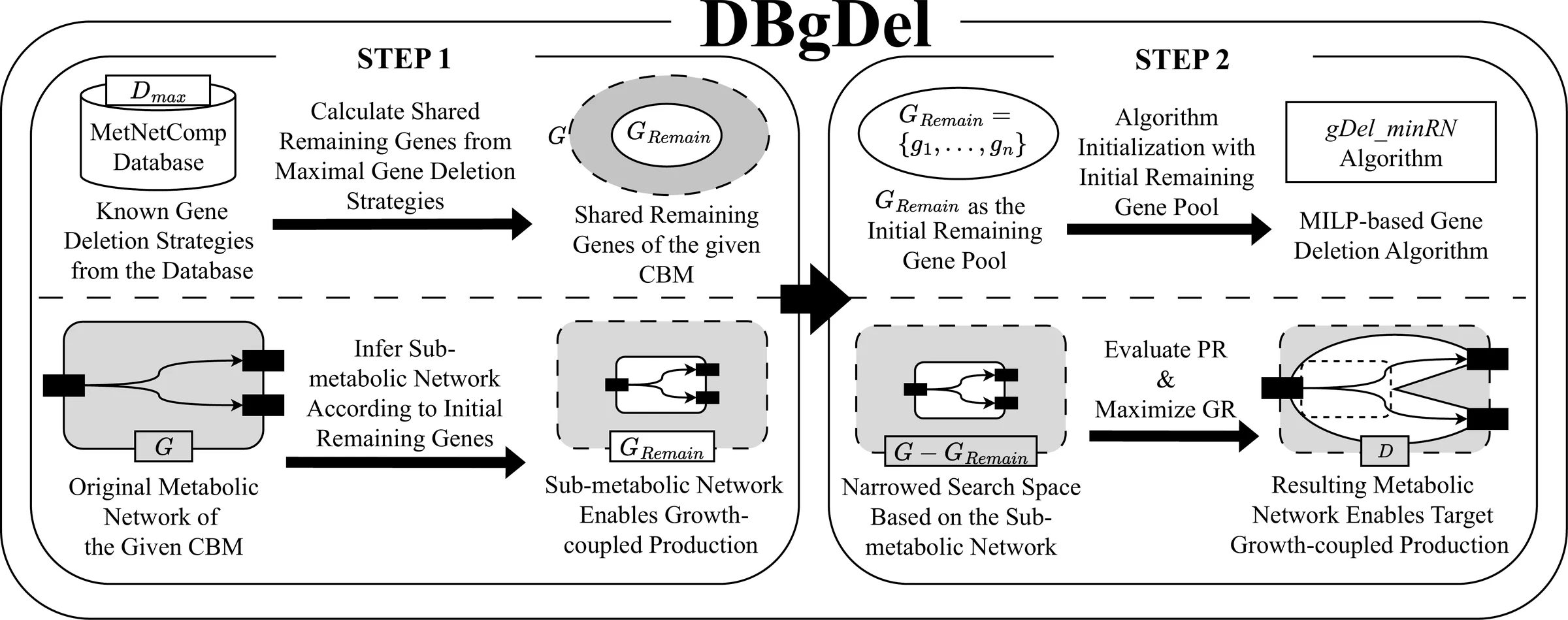
Designing a strain for growth-coupled production means finding a set of genes to delete in a genome-scale metabolic model so that the cell can only grow while making the target compound. The number of possible deletions grows quickly with model size: on the genome-scale iML1515 model, the previous best method, gDel_minRN, needed about 2,500 seconds per target metabolite on average.
Databases such as MetNetComp already store computed strategies for many metabolites. DBgDel treats them as prior knowledge. Genes that none of the stored maximal strategies delete mark a core sub-network that supports growth-coupled production, so they can be kept from the start.
The search then only has to decide the remaining genes. The paper also reports a small e_coli_core test that plugs a different algorithm, gMCSE, into the same framework.
Two steps, shown in the figure above.
Collect the maximal deletion strategies stored for the model's other metabolites and keep the genes that none of them delete. These form the initial remaining gene pool, which defines a sub-network that can support growth-coupled production.
Run an extended gDel_minRN that starts from this gene pool, so the MILP only decides the other genes. Candidates are checked by maximizing growth (GR) and evaluating target production (PR).
Against gDel_minRN, the previous best method
On iML1515, GDLS, gMCSE and optGene solved none of the 991 targets. A target counts as solved when growth rate and production rate both reach at least 0.001 under growth maximization.
DBgDel: Database-Enhanced Gene Deletion Framework for Growth-Coupled Production in Genome-Scale Metabolic Models