Ziwei Yang, Ph.D.
03 · Discover Biology · AI Agents for Scientific Discovery

DeepEvidence

A deep research agent for biomedical evidence

DeepEvidence is a multi-agent deep research system that searches biomedical knowledge bases and the literature, records what it finds in an evidence graph, and uses that graph to answer research questions with traceable support.

AI AgentsBiomedical Knowledge Graphs Zifeng Wang, Zheng Chen, Ziwei Yang, Xuan Wang, Qiao Jin, Yifan Peng, Zhiyong Lu, Jimeng Sun · Nature Machine Intelligence, 2026
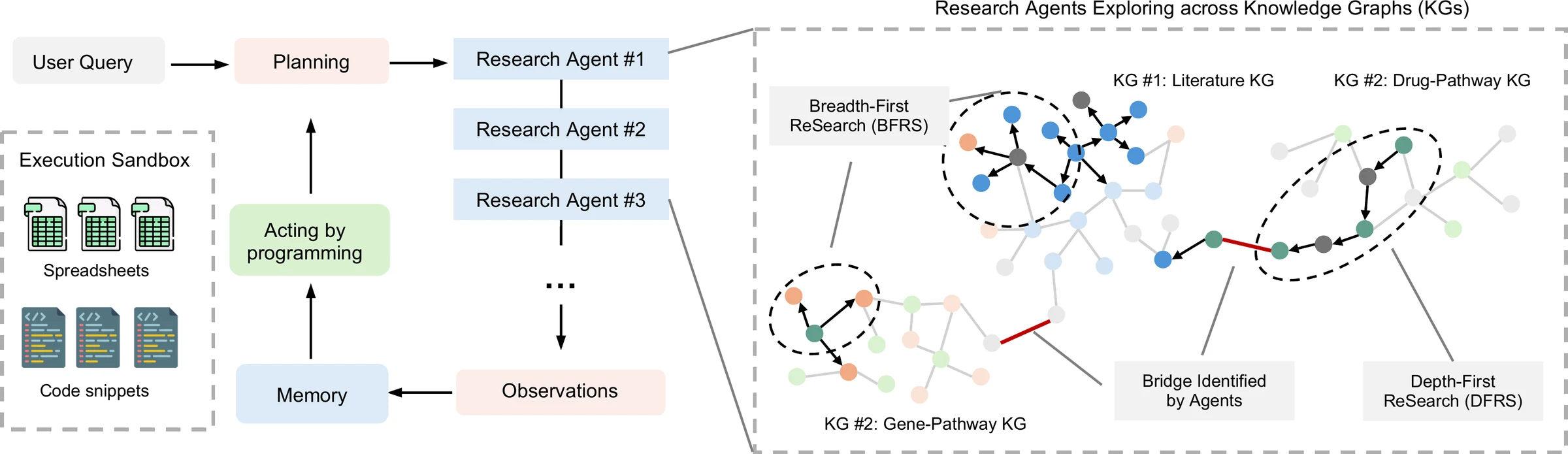
DeepEvidence system overview: a user query goes to planning, which dispatches research agents; agents act by programming in an execution sandbox with spreadsheets and code snippets, and observations update memory. On the right, research agents explore a literature knowledge graph, a drug-pathway graph and a gene-pathway graph, with breadth-first and depth-first research and bridges identified between graphs.
DeepEvidence at a glance. An orchestrator plans the research and dispatches research agents. They explore several knowledge graphs breadth-first (BFRS) and depth-first (DFRS), find bridges between graphs, act by writing code in a sandbox, and report observations back to memory. Figure adapted from Wang et al., Nature Machine Intelligence 2026 (preprint version, arXiv:2601.11560, CC BY 4.0).

Overview

A biomedical research question usually needs evidence from many places: the literature, drug and chemical databases, gene and pathway resources, clinical trials. Each source has its own structure and identifiers, and general-purpose AI agents tend to search text broadly but not deeply.

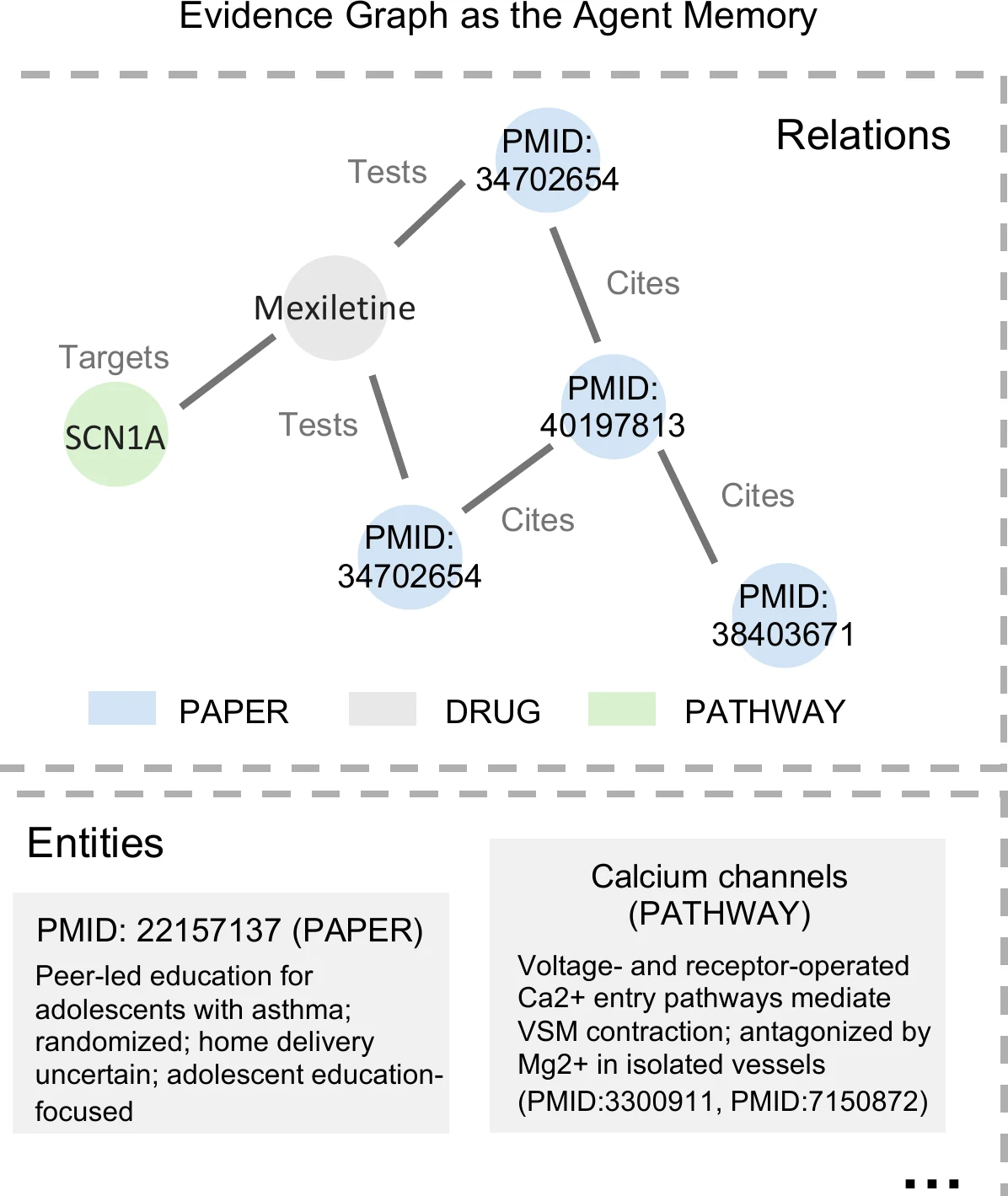
DeepEvidence is built for this. An orchestrator coordinates two kinds of research agents: breadth-first agents that search widely across knowledge bases for relevant entities, and depth-first agents that follow multi-hop chains of evidence. What they find is written into an evidence graph of entities, relations and sources, which serves as the system's memory and makes the final answer traceable.

It was evaluated on four open benchmarks and on seven new tasks covering drug discovery, preclinical research, clinical trial development and evidence-based medicine.

Method

An orchestrator, two kinds of research agents, and a shared evidence graph.

Example evidence graph: the drug mexiletine targets the pathway SCN1A and is tested in papers identified by PMID, which cite each other; below, entity cards summarise a paper and a calcium-channel pathway with their PMIDs.
The evidence graph as the agent's memory: papers, drugs and pathways linked by relations such as targets, tests and cites, each entity with a short summary and its sources. Figure adapted from Wang et al., Nature Machine Intelligence 2026 (preprint version, arXiv:2601.11560, CC BY 4.0).
  1. 01

    Plan

    The orchestrator turns the question into a step-by-step plan, decides which research agent to call next, and updates the plan as results arrive.

  2. 02

    Explore breadth-first and depth-first

    BFRS agents run broad searches across knowledge bases to find good starting entities. DFRS agents follow multi-hop chains of evidence from those seeds.

  3. 03

    Record, review, answer

    Findings go into the evidence graph with their sources. The agents review the graph to decide whether to keep searching or finish, and can write and run code in a sandbox along the way.

Key Results

Accuracy on open benchmarks

40.0%
HLE-Medicine
best baseline (Biomni): 20.0%
64.7%
LabBench-LitQA2
best baseline (GPT-5): 50.0%
96.0%
TrialPanorama-EvidenceQA
best baseline (Sonnet-4.5): 88.0%

All agent systems, DeepEvidence included, ran on GPT-5. On the new target identification task, DeepEvidence answered 17 of 25 questions correctly (68%), against 56% for Biomni and 40% for ToolUniverse.

Benchmark

Accuracy on four open benchmarks DeepEvidenceBaselines
HLE-Medicine
GPT-5 3.3
Sonnet-4.5 10.0
ToolUniverse 6.7
Biomni 20.0
DeepEvidence 40.0
LabBench-LitQA2
GPT-5 50.0
Sonnet-4.5 44.0
ToolUniverse 25.0
Biomni 48.9
DeepEvidence 64.7
SuperGPQA-Medicine-Hard
GPT-5 29.4
Sonnet-4.5 43.6
ToolUniverse 37.2
Biomni 40.7
DeepEvidence 47.1
TrialPanorama-EvidenceQA
GPT-5 72.0
Sonnet-4.5 88.0
ToolUniverse 73.7
Biomni 84.0
DeepEvidence 96.0
Accuracy (%). GPT-5 and Sonnet-4.5 are LLMs with literature search; ToolUniverse and Biomni are general-purpose biomedical agents; all agents use GPT-5. Data from the published Source Data for Fig. 1e; redrawn.

Resources

Paper

Empowering biomedical evidence exploration and synthesis with deep knowledge graph research

Nature Machine Intelligence 2026 · free author manuscript on PMC · preprint on arXiv

Code

RyanWangZf/BioDSA · agents/deepevidence

Agent implementation, at the version linked from the paper

Data

zifeng-ai/DeepEvidence

Benchmark test sets used in the paper